
Bankruptcies Rising?
Anecdotally, stress is definitely on the rise. Some of it is making headlines, as reported here.
And yet, the number as a proportion is unremarkable, and leaning on a more leading indicator, the folks at aie.ag find little to report: https://aei.ag/overview/article/trouble-brewing-not-in-farm-loan-delinquency-data.
An unplanned exit from agriculture doesn't require a bankruptcy filing, of course. And current or imminent delinquencies can vanish at the stroke of a pen...a refi against still-high land values, or a simple extension. Elsewhere, masking unresolved problems has been well-documented and even has its own title: "extend and pretend." Often enough, the rationale behind either is the hope that a problem can simply be waited out.
Therein is the rub: there is extensive historical precedent that suggests that many problems do simply vanish on their own. Or seem to. A whole generation of senior loan officers and credit analysts are 20+ years into careers and very well-seasoned--short of having personally experienced a major general reset such as we had in the 80s. Rather, their career experience (and mine too but for my pessimistic bent and Tom Sr.'s tutelage) has been that every rush to the brink of a broad illiquidity event is stayed by the fortuitous convergence of markets/government payments/high yields.
The near miss in 2018/19 was immediately countered by record government payments in '20 and a three-year bull market in the three following years. 2025 seemed to threaten a replay, but record yields, solid prices, and (perhaps surprisingly), second-highest in 25 years government payments AND 4th-highest insurance payments held working capital in place.
Crisis averted? We think it's deferred at best. As ever, AEI's thoughtful workup sent me to our own databases to fact check their findings on a more local, granular level.
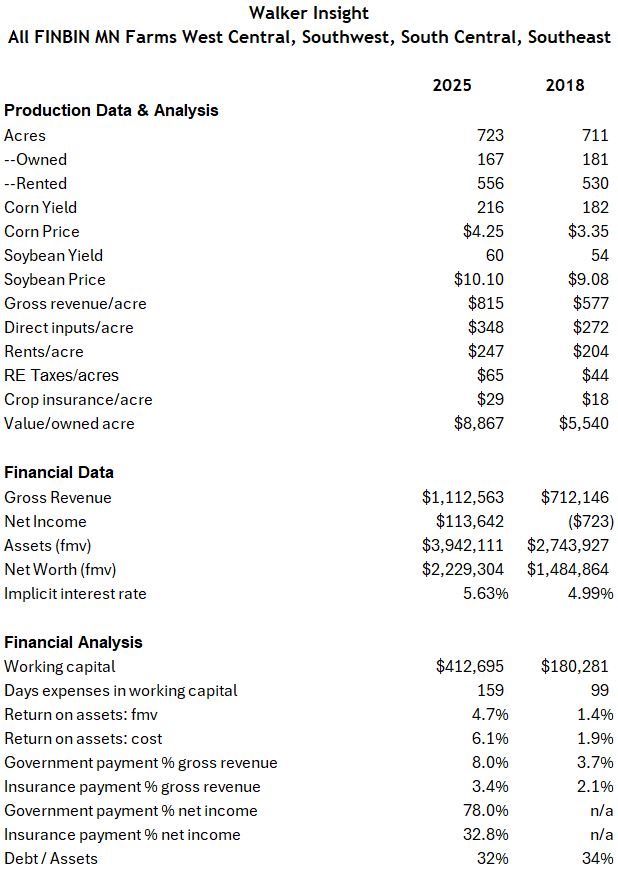
'25 does look more positive, but there's a whole mess of but-fors--
The outcome is very dependent on record yields and very high gov't and insurance payments both. Either the lesson is we're in trouble, or that the government will always bail the industry out. I propose a third: for such a trifecta of good outcomes this is very weak performance.
The historical lesson is that eventually no subsidy is big enough to stop a rush for the exits.
With rising interest rates ROA a 6% ROA might soon prove insufficient.
Debt to assets is improved but look at land. It's quite dependent on the believability of these valuations (economically on thin ice).
I'm not interested in proving that doomers or optimists are correct here. You might think that people, as the numbers came in, breathed a collective sigh of relief, but as AEI also notes in their analysis, that doesn't change the stress this year as everyone struggles with falling crop prices, rising input costs, and no particular guarantee as to what level of support the government will patch in.
It's likely that signs of stress, as is already happening, will appear locally before they're show up at all in the macro data. As Tom Sr. has long said, "Averages hide as much as they reveal."